In the immediate vicinity of the estate, trails offer absolute tranquility, making it easy to observe majestic birds of prey and small Canarian endemic species. This field guide details which species can be spotted around our accommodation and how to identify them.
For a fruitful birdwatching experience, the area offers two main itineraries with contrasting landscapes, allowing for the observation of a highly diverse fauna just a short distance from the villa.
This trail, which descends towards the Canarian Garden, follows the ravine bed. It's a sheltered environment, characterized by higher humidity, impressive oases of Canarian palm trees (Phoenix canariensis), and riparian vegetation.
Observation Profile: Birds associated with traditional crops and areas of high tree density.
Key species on this route:
-The Grey Wagtail (Motacilla cinerea canariensis): This is the Canarian Grey Wagtail. Look for it in runoff areas or old irrigation channels at the bottom of the ravine. It's easily identified by its bright yellow belly and the constant vertical bobbing of its tail.
-The Wild Canary (Serinus canaria): Very abundant in the reed beds of Guiniguada. Unlike domestic birds, its plumage is olive green and brown for camouflage in its environment, but it retains a spectacular and melodious song.
-The Canarian Blue Tit (Cyanistes teneriffae hedwigii): Frequents the tops of palm trees and willows, moving acrobatically. It stands out for its cobalt blue cap. The hedwigii subspecies is an exclusive endemic to the island of Gran Canaria.
-Canarian Blackbird (Turdus merula cabrerae): An indigenous subspecies, very active on damp ground and among leaf litter searching for food.
.jpg)
In contrast to the bottom of the ravine, this route ascends towards a more exposed mid-altitude area. The landscape opens up into a mosaic of hillsides, traditional agriculture, and remnants of thermophilic forest (mastic trees and wild olive trees).
Observation Profile: Large birds of prey in flight and birds from shady forest ecosystems.
Key species on this route:
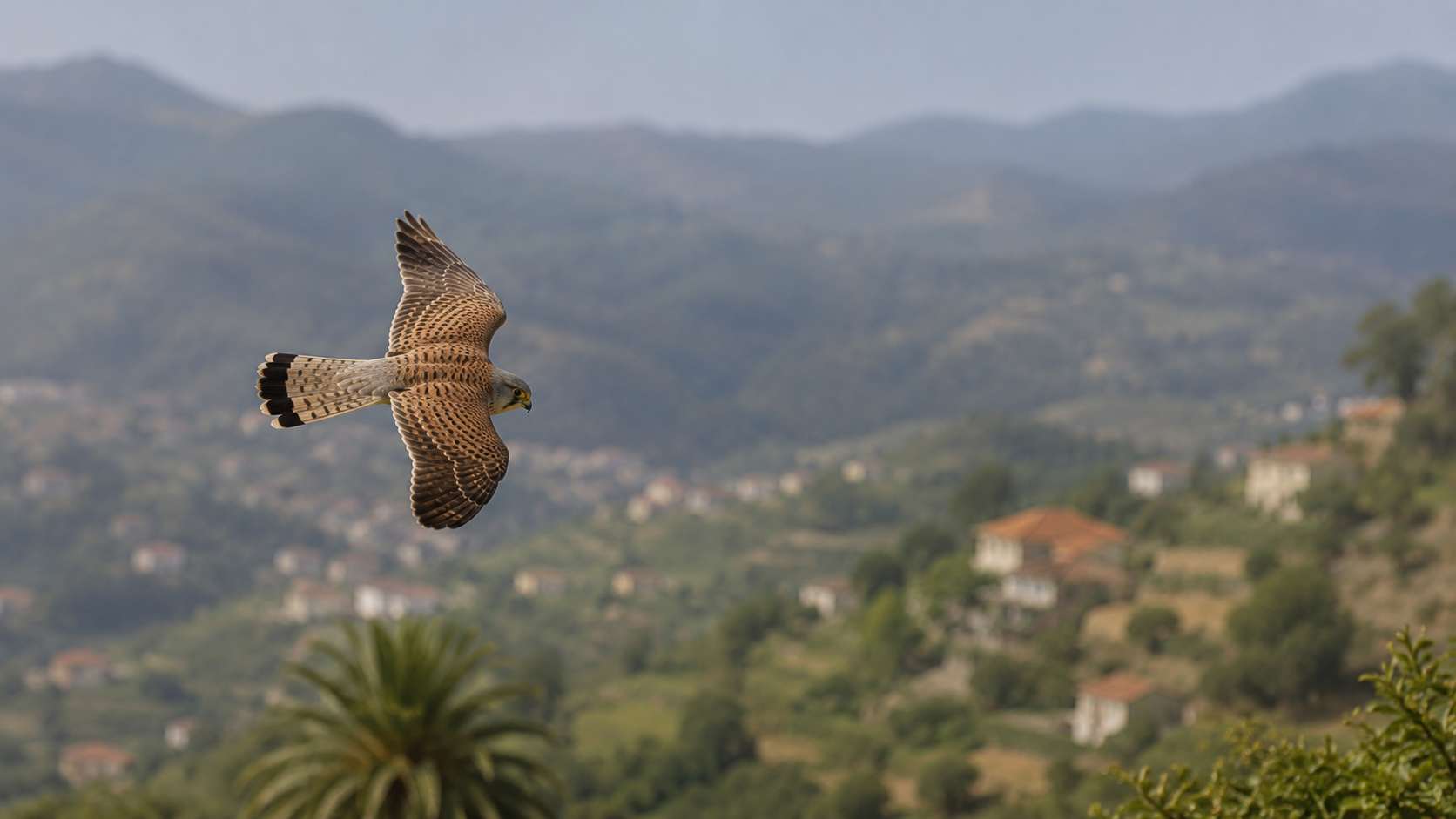
-Common Kestrel (Falco tinnunculus canariensis): Dominates the open skies of Pino Santo. It's easy to spot it perched high on cliffs or "hovering" (remaining suspended statically in the air, flapping its wings) before diving for its prey.
-Common Buzzard (Buteo buteo insularum): This is the largest diurnal raptor in the area. On clear days, pairs take advantage of thermal currents to majestically circle above the ravines.
-Gran Canaria Robin (Erithacus rubecula superbus): Exclusively inhabits the shadier, more wooded sections of the trail. Its chest displays
a much brighter reddish-orange than that of the European robin and has a very distinct white eye-ring.
How to differentiate raptors in the Santa Brígida sky? If the flight is low and the bird remains suspended at a fixed point, rapidly flapping its wings, it's a kestrel (Falco tinnunculus). If you observe a slow, circular glide at high altitude, taking advantage of the ravine's currents, it's a buzzard (Buteo buteo).
What are the exclusive ornithological gems of the area? The Canary Blue Tit (Cyanistes teneriffae hedwigii) and the Gran Canaria Robin (Erithacus rubecula superbus) are endemic subspecies with unique morphological variations on this island, making the trails near the property highly valuable sites for their observation.